Showing posts with label Read 'n' Seed. Show all posts

Thursday, December 10, 2009

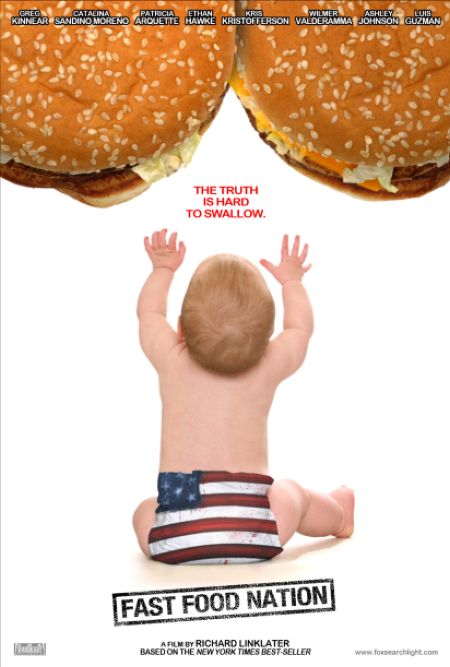
Read 'n' Seed 6: Final Review of "Fast Food Nation"


Overview of Book:
Fast Food Nation was a very eye opening read, and I think that is really the purpose behind this book.  The author, Eric Schlosser, goes behind the scenes of mainly the fast food industry along with the meatpacking industry, digging up the truth behind the all American meal.  He meets and interviews real people working in these industries as well as individuals who have been negatively affected by these industries.  Schlosser does a great job of putting the familiar saying "you are what you eat" into context.  This book is a great read for anyone looking to become more informed about what they are putting into their bodies, and it's effects on the environment.
Three Significant Issues:
The three main issues that have really stuck with me after finishing this book are: employee treatment, slaughterhouse conditions, and the overall effects the fast food industry has had on the environment.  All over the world fast food employees are being paid poorly and mistreated.  They are being taken advantage of mainly because of their age and their lack of experience out in the "working world".  Also employees of slaughterhouses are being injured and barely taken care of.  Slaughterhouse employees have one of the highest injury rates in the U.S.  They are getting injured on the job and forced to return to work with a very limited amount of time to recover if they get any recovery time at all.  The slaughterhouses are also extremely disgusting in my opinion.  Because of the demand for meat from the fast food industry they are pushing their employees to the limit and carelessly handling our food in the process.  E-coli has now become a major concern for individuals who consume meat products, which in the past, before there was such a demand for meat, E-coli was not such a problem because meat was handled with more care.  Lastly, the more that these fast food chains keep popping up, the more that our environment is going to suffer.  When a building goes up, more land is taken away, more food needs to be processed, the more food that needs to be processed, the grain and resources are going to be used.  It is a viscous cycle!  All of these things add up and they are harming our planet, not helping it.  We the consumer have been consumed by the fast food industry!  The more we know about this topic gives us the ability to do more about the problem.
Meaning and Importance:
The topics discussed in this book are important to me because in the long run they affect me, my family, and everything on earth really.  Without the environment where would we be?  We wouldn't be, it is as simple as that!  This book has really opened up my eyes to what is going on in the fast food industry and has given  me some great knowledge.  Again, I feel that the more that you know the more you can do to prevent/reduce the problem.
Recommendation: 
I would most definitely recommend this book to others!  I have been saying this all semester long, that I want everyone to learn what I have learned from this book.  I don't think that this book covers everything that people should know about this topics, but I think it is a great starting place to become more engaged in what is going on in the fast food industry.  So, if you are looking for a great read that is informative and will get you thinking critically, this is the book for you!

Thursday, December 3, 2009

Read 'n' Seed: Fourth Quarter of "Fast Food Nation"


Chapters and Pages Covered:
The last chapters of Fast Food Nation that I read were chapter 9, chapter 10, and the epilogue.  I started at page 191 and ended at 283.
Main Topics:

In chapter 9 the main topics that were talked about were food-borne pathogens, specifically focusing on E-coli.  During the 1980's changes in the meatpacking industry lead to increased risk of widespread contamination, leading to many people being affected by E-coli.  Eric Schossler interviewed a man who had eat a frozen pre made hamburger and had gotten sick from it.  He ended up having E-coli, but by the time that it had gotten traced back to the hamburger he had eaten, other people had gotten E-coli from those meat products.  Many other outbreaks have occurred and the main people who have been affected by it have been children.  Something sad that I found out in this chapter is that if a company puts out a meat product that has to be re-called they are the one's who get to decide how much they recall.  The main way that E-coli is passed to meat is actually through cattle manure.  Something very disturbing to learn.  However, today many fast food companies have agreed to have microbial testing done to their meat before it is given out to the public.
In Chapter 10 the main topics were the globalization of fast food restaurants, specifically looking at McDonalds and it's effects on other companies such as the food processing industry.  Mr. Schossler traveled to Germany only to find that even in the most remote places McDonald's restaurants were popping up.  Something that really hit home with me was reading about how just three miles away from the Dachau concentration camp a McDonalds was built.  This is disturbing to me in so many ways, but especially because I have personally been to that concentration camp and it just does not seem fitting that a McDonalds be right next door.  Dachau was a terrible place were thousands were killed.  It is sad that a McDonalds is just put up there as if it is a normal everyday location where people should come to enjoy a nice fast food meal.  I feel that it is a place where people should come to remember the past, not indulge in a greasy hamburger.
The last part of this book that I read was the epilogue entitled Have it Your Way.  This chapter started on a more hopeful note, by describing a family owned business who does not believe in the McDonalds way of running things and is pretty environmentally friendly.  They raise their own cattle, feed them organically, and form their own hamburgers everyday.  This is what the fast food industry should be like! Basically the epilogue pointed out that we can have it our way, we can either take it or leave it.  The way that we advertise for fast food companies, the many costs that we pay because of eating fast food, and this is not just financially but personally as well.  Food safety should be important to all Americans especially congress who can control laws around food safety.  This was a great way to end this book, basically putting it in the readers hands.  Mr. Schossler has presented all kinds of information throughout this book, and it is now the readers turn to choose whether or not to do anything about it.
Terminology/Things I Learned:
Again there wasn't really a lot of terminology in this section of the book, but there was plenty to learn.  I think that the main thing that I took away from this part of the book is that the fast food industry has just become such a part of the entire world's view of the American way of eating.  This is sad to me, but I know that it is true.  Also when it comes to E-coli and it's relationship with the fast food industry I learned that a single plant can produce 800,000 pounds of hamburger, and just one animal infected with E-coli can contaminate 32,000 pounds of that meat simply because of how ground beef is made these days.
Implications: 
Everyone is affected by the fast food industry whether they like to believe it or not.  The fast food industry is inter-connected with so many other industries that it is hard not to feed the fire.  There are many implications for the widespread growth of the fast food industry, it is literally taking over the world!  Individuals are working in poor conditions, people are becoming sick from the food, and lines are being crossed by the building of fast food restaurants in various locations.  I have found so many implications from this book, which has been very eye opening for me.  I truly wish that everyone in class could have read this book, I want everyone to learn what I have learned!

Friday, November 13, 2009

Read 'n' Seed 4: Third Quarter of "Fast Food Nation"


Chapters and Pages Covered:
The third quarter of the book was chapters six, seven, and eight, consisting of pages 133-190.

Main Topics:
In chapter six the main topics that were discussed were price controlling of meat, and how the top meat buyers are only buying from high up companies, not the actual hard working ranchers.  Also poultry started going through the same price holding problem as meat, showing up all the way back when McDonalds first came out with the chicken Mc nugget.  This chapter was hard to read, just because I really felt for the people running the ranches out west, they are the ones working their butts off, yet they are making barely any money off of their cattle, and for many the money that they are making doesn't cover the costs of living and running the ranch so they end up in debt.
In chapter seven the main topic was that of meatpacking companies.  There are many meatpacking companies around the United States, and the largest of them is controlled by ConAgra .  While in the previous chapter I learned of one rancher who was raising his cattle on the natural grass land, the feedlots that ConAgra runs are only feeding their cattle grain, and a lot of grain!  A typical steer will consume more than three thousand pounds of grain during it's stay at a feedlot, all to make the cow gain four hundred pounds.  This is crazy to me, considering what we learned about grain and how wasteful it is to feed it to cows.  This chapter also looked at immigrants working for the meatpacking companies, and how they were taken advantage of being paid poorly, while also working in a hazardous environment.  Normal everyday towns are being turned into ghettos were there is violence and crime, which is scary to think of.  These meatpacking companies are only thinking of themselves and making a profit, they clearly don't care about the people who reside in the community.
Lastly, in chapter eight a whole slew of topics were touched on, but the main ones were what goes on behind the scenes at a slaughterhouse and the injuries that occur at the slaughterhouse.  I will admit that reading about the slaughterhouses and what they do to the cows, and just how the whole thing is ran really made me sad, almost to the point of tears.  Then to find out at the end of the chapter that a man who was a loyal worker at a slaughterhouse for many years, and was hospitalized many and I mean MANY times because of the injuries he got while on the job, was fired without even receiving a phone call really upset me.  The scariest thing of all is that OSHA wasn't even concerned about what was going on at these slaughterhouses.  All in all this chapter was very hard to read!

Terminology/Things I Learned:
There wasn't really any terminology to learn in these chapters, but there definitely was plenty of information to take in.  After reading chapter eight I am completely horrified and disgusted with slaughterhouses that treat animals so badly!  I think the biggest thing I am taking away from these three chapters is that animals, and people are treated so poorly when it comes to the meat industry!  I honestly am saddened that this is how things are run!!!

Implications:
I don't even know where to start with how upset I am about how things are run in this country.  I feel like the implications list could go on and on, but to me the major implications would have to be that we are taking work away from hard working americans, we are being extremely wasteful by feeding all of these cattle grain, we are endangering the lives of Americans and immigrants, and sadly all of this is being done because of the demand for meat by the American people.  I don't remember the statistic of how much meat a person in the United States eats annually, but I do know that we are eating too much!  I wish I could make everyone read chapters six, seven, and eight just to get an idea of what's really happening behind the scenes of the meat industry!

Friday, October 30, 2009

Read 'n' Seed 3: Second Quarter of "Fast Food Nation"


Chapters & Pages Covered:
The second half of Fast Food Nation that I read consisted of chapters three, four, and five, from page fifty-nine to page one thirty one.
Main Topics:
Chapter three is entitled behind the counter, and was a very interesting read!  The main topics that were discussed in this chapter had to do with where fast food is coming from and how employees are treated.  Fast food restaurants are receiving the food that they assemble in precooked, frozen form that have been vacuum-sealed in plastic bags.  An example from the book was that the guacomole that is soled in Taco Bell restaurants isn't made at Taco Bell, but in a factory in Michoacan Mexico, and then shipped all over the United States to Taco Bell restaurants.  The main employees at fast food restaurants are people under the age of twenty, this age group has been chosen simply because they lack experience, meaning they don't know when they are being screwed over by a company, and they don't need to have a lot of skill to work in the fast food industry.
Chapter four entitled Success, was all about franchises and how being able to franchise many fast food restaurants has contributed to the success and widespread of fast food restaurants.  Franchises are appealing to people who are looking to make money, and also the executives who own the entire company (ex. little ceasars).  Throughout this chapter many individuals were brought up and their success stories were told, but at the end of the chapter Christopher Reeves spoke to a group of fast food workers and executives stating that while you may be on top now, everything can fall apart in an instant.  All in all this was an interesting chapter.
Chapter five which started the beginning of part two of the book: Meat and Potatoes, was entitled Why the Fries Taste Good.  Just by the name of this chapter I knew this was going to be good!  The disturbing reason why the fries taste so good lies within the flavoring companies that are adding chemicals to our foods.  The fast food industry is made up of processed foods and sees nothing wrong with this.  Something interesting I read was that out of every $1.50 spent on a large order of fries at a fast food restaurant, only 2 cents of that is going to the farmer who grew the potatoes.  Family potato farms are being over taken by HUGE corporate potato farms.
Terminology/Things Learned:
Out of everything that I read one term stuck out to me that I didn't know before reading this part of the book.  It is called throughput, which is a factory's speed and volume of it's flow, a much more crucial measurement, than the number of workers it employs or the value of it's machinery (Fast Food Nation, 68).   This term to me basically shows that at the end of the day a business is a business and they don't care what they have to do as long as they are making a profit.
Implications:
Everything that I learned from this part of the book is extremely important.  Not only are these fast food restaurants harming our environment by shipping frozen food all over the United States and producing these foods in big factories, but these food are also extremely unhealthy for people, yet these businesses could care less.  We need to start caring about what we are putting into our bodies and where this food is coming from.  I am extremely excited to keep reading, because this book is really starting to get interesting!

Friday, October 16, 2009

Reed 'n' Seed: First Quarter of "Fast Food Nation"

The first section of "Fast Food Nation" that I read was pages 1-59, which included the introduction, and two chapters out of section 1,The American Way, called The Founding Fathers and Your Trusted Friends.
The main topics that were discussed in this part of the book were: where fast food started, who started it, advertising for fast food, the comparison of Disneyland and McDonalds, creating a brand, and about who is eating fast food. It was actually really interesting to read about all of these young men that really came from nothing who worked their way up to owning and running these highly successful fast food restaurants! Many of these men were from the east coast or the midwest, and moved west to start a whole new life, which they truly did. It was also interesting to read about the fact that like Disneyland, McDonalds and other fast food restaurants were using similar strategies for becoming such a widespread business. At one point in the book the author touched on advertisement strategies that restaurants like McDonalds were using which were solely meant for kids, and how their are even journals out that teach people how to advertise to children.
One of the most surprising things I learned from reading this book thus far would have to be how fast fast food restaurants came to be. It was really sad to read about how these men traveled to California where there were rows upon rows of peaches, and lemons as far as they could see, but by the time a number of fast food restaurants had opened up not a single row of peaches or lemons was left standing. A term that I learned while reading that I also found interesting was synergy, which is the term used to describe a situation where different entities cooperate advantageously for a final outcome. Simply defined, it means that the whole is greater than the sum of the individual parts. I found this interesting because without the help of all of it's workers none of these restaurants would exist, yet the interest is really only for the company not the employee.
I feel like there is so much more I could write about, but the last thing I want to talk about is the implications of all of these fast food restaurants all over the place.  At the beginning of the introduction the author was talking about the Cheyenne Mountains and how beautiful they are, and how when we think of an old western movie the background would look something similar to the breath taking Cheyenne Mountains.  Yet we know that within the Cheyenne Mountains are the headquarters for North American Aerospace Command, The Air Force Space Command, and the United States Space Command.  This mountain has been turned into and underground city, which is highly guarded, and is strong enough to withstand being hit by a bomb.  Surprisingly enough within the highly guarded mountain you will find McDonalds rappers, Burger king boxes, and even a dominos box.  FAST FOOD IS EVERYWHERE!  Too many people are eating fast food, and too much of it!  The book hasn't really gone into where the meat is coming from and things like that, but I will definitely be keeping everyone up to date when I do read about those kinds of things.  Below is a picture of the entrance tunnel, in the Cheyenne Mountains, to the North American Aerospace Command, just to give you a visual!

Friday, October 2, 2009

Read 'n' Seed 1: Fast Food Nation

The title of  my book is Fast Food Nation: the dark side of the all-american meal, written by Eric Schlosser.

This book takes an in depth look at the "American" style of eating, and how our eating culture is affecting our lives.  Eric Schlosser who is an award winning journalists, exposes what is really happening behind the scenes at your local McDonalds, and is taking and even deeper look at where our food is coming from, and how employees are being treated in the fast food industry.  With one out of four people stopping in at a fast food restaurant for a quick fix lunch you can clearly see that more people need to be informed about what they are actually putting in their mouth, this book should be a great tool for many Americans!

The reason I chose this book is because I am really interested in obesity, and one of the factors why the United States is having an obesity epidemic has to do with the foods people are eating.  I am really interested in learning where exactly the food that millions of Americans are consuming is coming from and what is happening to our environment as a result all of these fast food restaurants popping up everywhere.  This book should be very eye opening, and I am excited to start reading it!

Below are three great sites to get more information about this book and the author, Eric Schlosser:
About Eric Schlosser and Fast Food Nation
Fast Food Nation Review
Fast Food Nation Speech/You Tube Clip

Fast Food Nation has 383 pages and is broken up into 10 chapters.  To break this into 4 sections I will be reading and writing about only two to three chapters at a time.

Hope you are all getting excited about your books too!  This should be a great learning experience for all of us!

Wednesday, September 23, 2009

Welcome to Hailey's Healthy Environment!


Hello, my name is Hailey Giller and I am a Community Health Education major from Luck, Wisconsin.  My blog this semester is going to be all about our ever changing environment and things that WE should be doing to keep the environment clean and safe.  Over the course of the semester I also want to learn as much as a I can about different health options out there that can help out our environment and pass on all of that information to anyone who wants to learn via my blog.

There are 6 possible types of posts on my blog. They include:
  1. Advocacy Project
  2. Eye Openers
  3. Reflections
  4. Eco-Chic Lifestyle Change
  5. Read 'n' Seed
  6. Share and Voice
If you notice at the bottom of this post, the categories will be listed as labels. This post has been labeled with all six kinds of posts.  All post titles from now on will begin with one of the categories above.

The members of my web group are:
  1. Hailey @ Hailey's Healthy Environment
  2. Jordanne @ Jordanne's Jungle
  3. Maggie @ Maggie's Environmental Lifestyle
  4. Karly @ Karly's Karing Habitat
You can subscribe to my blog by clicking the subscribe gadget in the gadget column. You can also follow my blog by clicking "Follow this Blog" in the gadget column. I am subscribed to all the blogs in my blog list gadget. You can see my complete profile and all the blogs I am following by clicking on "See Complete Profile."

Thanks for visiting my blog, this should be an exciting semester!

Hailey@Hailey's Healthy Enrvironment

Blogged for the Welcome Linky Party hosted by Amy@Eco-Chic with Amy